An owner-focused guide to planning, witnessing and documenting fire-pump testing and commissioning for Abu Dhabi projects.
A fire pump is expected to work on the worst day of a building’s life. Yet many handover problems begin long before the witnessed test: the pump room is incomplete, the water source is uncertain, controllers are not coordinated, valves are not in their final position, or records do not match the installed system.
For owners, developers and contractors in Abu Dhabi, fire-pump testing should be managed as an engineering verification process—not a last-minute demonstration. A successful test must connect approved design information, installed equipment, electrical and control interfaces, measured performance, defect closure and final operating records.
What fire-pump commissioning is meant to prove
Commissioning provides evidence that the installed fire-pump system is complete, correctly configured and capable of supporting the approved fire-protection design. It is wider than starting the pump and observing discharge pressure.
The project-specific test plan should identify the applicable approved drawings, equipment data, acceptance criteria, measuring instruments, operating modes, witnesses and records. Requirements must be confirmed against the current UAE Fire and Life Safety Code of Practice, relevant referenced standards, ADCDA directions and the project’s approvals.
Build a readiness review before booking the test
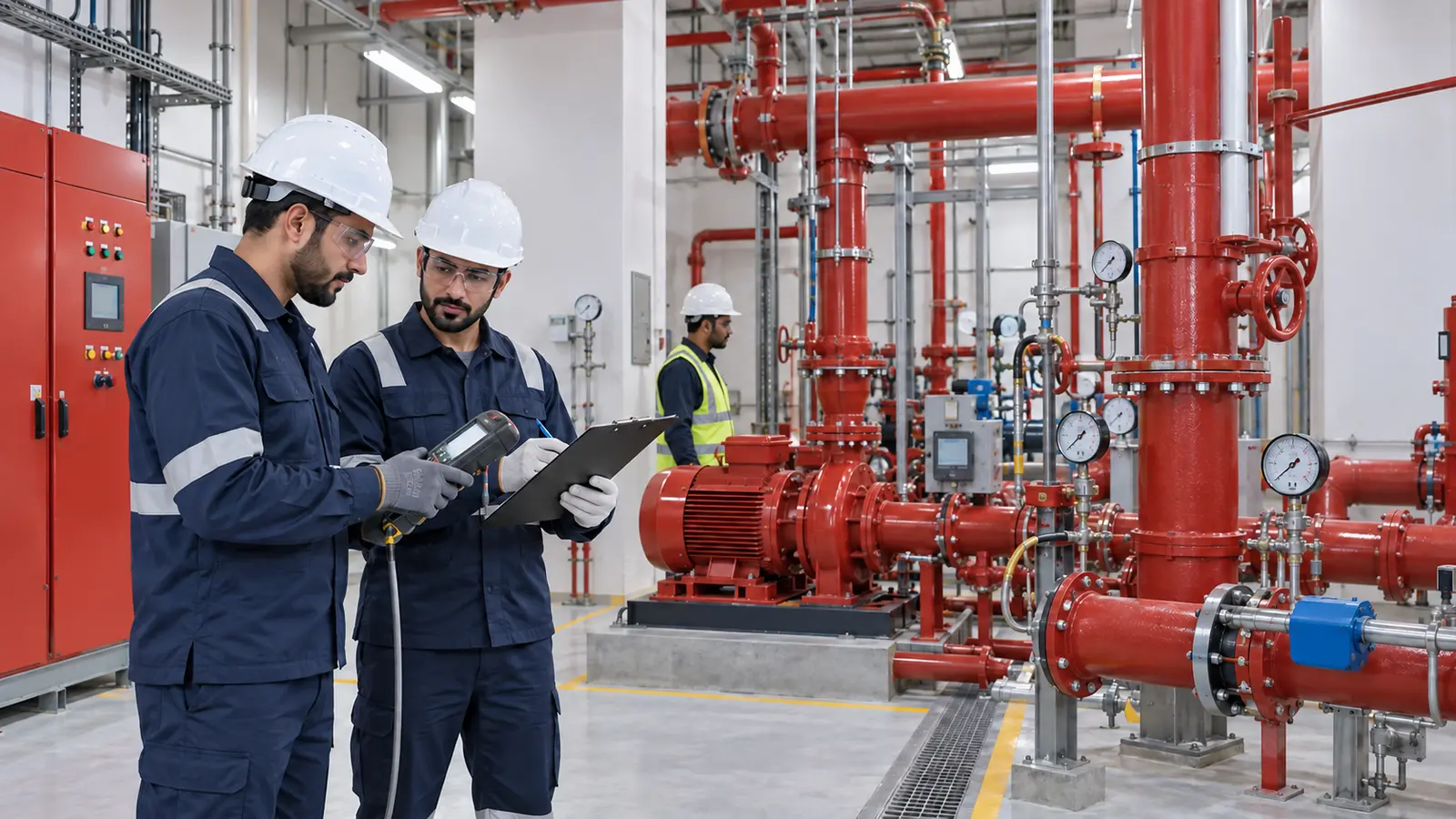
A witnessed test is expensive to repeat. Before requesting attendance, the responsible team should complete a documented readiness review. That review should confirm at least the following:
- approved fire-protection drawings, hydraulic information and pump schedules are available;
- the selected pump, driver, controller and accessories match approved submittals;
- the water tank or approved source is complete and available at the required operating condition;
- suction and discharge arrangements, test header or flow-measurement route, relief provisions and drainage are ready;
- valves are identified, accessible and placed in the intended normal position;
- permanent power, standby power and controller supplies are available where applicable;
- alarm, supervisory and building-management interfaces have been point-checked;
- the pump room has safe access, lighting, ventilation and housekeeping;
- instruments have current calibration evidence; and
- the test method, responsibilities and stop conditions have been briefed.
This review should cover the complete arrangement, including duty, standby and jockey pumps where they form part of the design. Testing one item in isolation can miss sequencing, controller or shared-header problems.
Records the owner should request
Good handover evidence lets another competent person understand what was tested, under which conditions, and whether the result matched the approved basis. A useful fire-pump commissioning file normally includes:
- approved equipment submittals and coordinated pump-room drawings;
- manufacturer data and certified pump performance information;
- pre-start checks and installation inspection records;
- instrument identification and calibration certificates;
- test readings at the required operating points and the acceptance comparison;
- controller, alarm, supervisory and power-failure test results;
- photographs or marked-up records identifying tested equipment and valve positions;
- a clear defect list, responsible party and closure evidence;
- approved changes reflected in as-built drawings; and
- operator training, maintenance information and final settings.
A signed sheet containing only one pressure reading is rarely enough to explain system performance. Results should be traceable to the equipment, instruments, test condition and design criteria.
Do not overlook electrical and control interfaces
Fire pumps depend on more than mechanical installation. Their controllers, power supplies, alarms, remote indications and starting logic must behave correctly during credible operating conditions. The exact sequence is project-specific, but the test plan should address the interfaces shown in the approved cause-and-effect and electrical documentation.
Where emergency or alternate power is part of the approved design, the test should verify transfer and operation in the required mode. Any simulated input must be recorded honestly; a simulation should not be described as a complete end-to-end test when field devices or upstream systems were excluded.
Common reasons tests fail or must be repeated
- The pump-room installation differs from the latest approved layout.
- The available water level or suction condition is not representative.
- The discharge test route cannot safely handle the required flow.
- Pressure gauges or flow instruments are missing, incorrectly ranged or out of calibration.
- Controller settings were changed without a controlled record.
- Alarm and supervisory signals do not reach the intended receiving system.
- Standby sequencing is not demonstrated after a duty-pump failure condition.
- Defects are noted but no evidence-based close-out process is assigned.
- As-built drawings are prepared from design files rather than verified site conditions.
Plan the authority and competency path early
Fire-protection testing and submission responsibilities should be agreed before handover. The ADCDA accreditation initiative announced in 2026 introduced a mandatory competency and classification route for consultancies submitting fire-protection system designs from 1 September 2026. Project teams should verify the current requirements, the authorised parties and the required witnesses for their specific project.
Abu Dhabi’s Binaa permitting platform also reflects increasing coordination among DMT, ADCDA and other entities. Owners benefit when approval comments, design revisions, inspection records and handover evidence are controlled within one project information process.
An owner-focused close-out checklist
- Freeze the approved basis. Identify the drawings, calculations, equipment data and comments governing the test.
- Complete pre-functional checks. Do not use the witnessed event to discover basic installation defects.
- Agree the method. Define instruments, test points, operating modes, witnesses and safety controls.
- Record actual results. Capture readings, conditions, deviations and observations without rewriting failed results.
- Close defects visibly. Retest affected functions and link closure evidence to the original item.
- Update the record set. Drawings, schedules, settings and asset information should describe the accepted installation.
- Train the operator. Explain normal status, weekly or periodic responsibilities, impairments, alarms and escalation routes according to the approved maintenance plan.
How Infinity MEA can support fire-pump handover
Infinity MEA combines fire-protection engineering with commissioning, electrical coordination and BIM review. Support can include design and submittal review, pump-room coordination, readiness inspections, test scripts, witnessed verification, issue tracking and as-built close-out.
The exact acceptance route depends on the building, system and current authority requirements. Contact Infinity MEA to review the readiness and evidence needed for your Abu Dhabi project.
Frequently asked questions
Is a manufacturer start-up the same as commissioning?
No. Manufacturer attendance can confirm equipment start-up and settings, but project commissioning also verifies installation, interfaces, operating modes, approved criteria, records and defect closure.
When should the fire-pump test plan be written?
During design and submittal coordination, then updated before testing. Early planning identifies missing test connections, drainage, access, power and control points before they become handover delays.
Should failed readings be removed from the final report?
No. The report should show the initial issue, corrective action and successful retest so the acceptance trail remains clear.
Can fire-pump testing proceed on temporary power?
Only when the approved test method and relevant parties accept the arrangement. Final acceptance normally needs evidence that the permanent approved power and control configuration performs as intended.
Speak with Infinity MEA about the coordination, performance, and delivery priorities affecting your project.
Contact our team Abu Dhabi Fire & Safety Engineering
 Abu Dhabi Fire & Safety Engineering